
The world's most electric car market
Norway registered 179,550 new cars in 2025 and 95.9% were fully electric. Denmark has passed 80% this year. The rest of the region is moving the same way, years ahead of the European average.
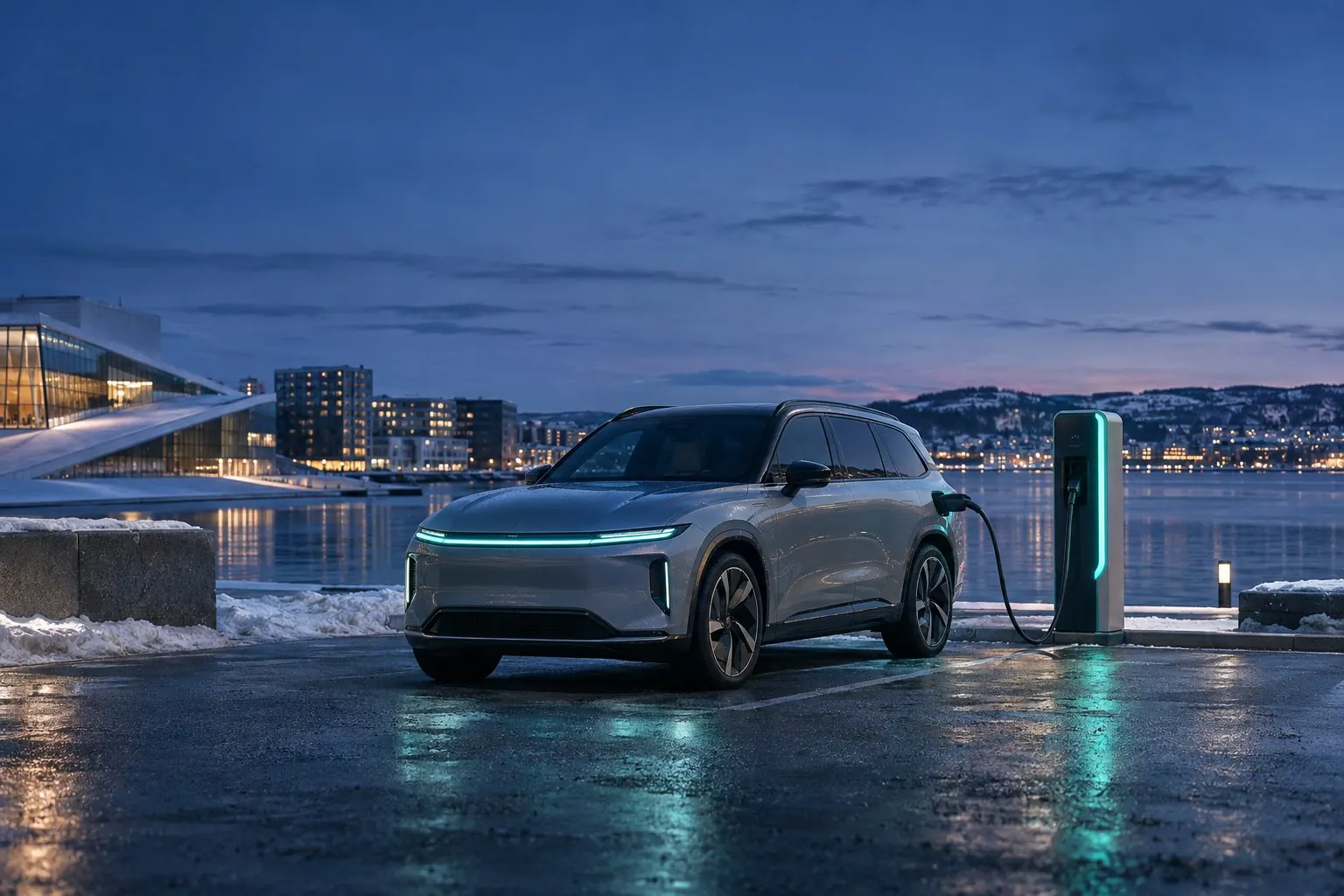
We are the Nordic partner for car makers entering Norway, Sweden, Denmark, Finland and Iceland. As your representative office we build the strategy and run the work on the ground, from importers and dealers to pricing, financing and campaigns.
Updated November 2026. Sources are listed at the bottom of the page. ↓
Five countries, around 724,000 new cars a year and the highest electric share in the world. For a car maker with competitive electric models, few regions in Europe offer a better start.
Norway registered 179,550 new cars in 2025 and 95.9% were fully electric. Denmark has passed 80% this year. The rest of the region is moving the same way, years ahead of the European average.
Both countries are in the EEA but outside the EU customs union. The EU duties on China-built electric cars, from 17% to 35.3% on top of 10% import duty, do not apply there.
Chinese brands took 13.7% of new cars in Norway in 2025, up from 10.4% the year before, and more than 20% in August 2026. Nordic buyers judge a car on range, price and technology.
Cold winters, independent winter range tests, critical press and demanding buyers make the Nordics a hard test. A car that does well here has a strong story for the rest of Europe.
The Nordics are one region for customers and press, but taxes, tariffs and buyer habits differ by country. Your plan has to be built per market.
No customs duty on cars. VAT applies to the part of an electric car's price above NOK 300,000 in 2026 and above NOK 150,000 in 2027, and to the full price from 2028. Prices have to be planned around these steps.
The largest market in the region. About half of private buyers lease their new car, so the monthly price matters more than the list price. A new premium of up to SEK 46,800 supports lower-income households outside the cities.
Electric cars pay 40% of the registration tax in 2026, rising to 48% in 2027 and step by step to full tax in 2036. Electric share is above 80% this year and private leasing is common.
No car tax on new fully electric cars. Most private buyers pay by instalments, and companies lease two out of three cars. Electric share passed 50% this year.
Outside the EU customs union. Excise duty on new electric cars was removed in 2026, a purchase grant of ISK 400,000 applies from November 2026, and all cars pay a charge per kilometre.
One region for customers, press and the large dealer groups, with around 724,000 new cars a year. Two out of three new cars sold this year are fully electric, against about one in four in Europe.
Two of the questions we get most often. The answers change how and where you should start.
A minimum price agreement with the EU can replace the duty. One model was accepted in February 2026.
Simplified. Does not include the one-off weight tax, delivery or registration.
The model decides who holds the stock, who sets the price and how much capital you tie up. We help you choose, and plan the next step from day one.
A Nordic importer buys the cars, holds the stock and builds the dealer network. Fast reach with little capital, but less control over price and brand. Several car makers have taken markets back from their importers once volume was there, so the contract must allow it.
You own the stock and set one national price. Dealers sell and deliver for a fixed fee. Clear prices for customers and more control, but more working capital.
Own stores and online sales. Full control and direct customer data, but costly in small markets. Several brands in the region have moved from direct sales to dealer partners.
Techstone acts as your local office. You keep control of brand, price and product, while importer, dealer and service partners handle stock, sales and workshops. You start lean and can set up your own company when volume justifies it.
More than fifteen Chinese car brands have entered the region since 2019. Some now sell thousands of cars a year, others have pulled back. The difference is rarely the car.
The Tesla Model Y sold 27,621 cars in Norway in 2025. Your price has to make sense next to it after local taxes, not next to your price at home.
About half of private buyers in Sweden lease their new car. A finance partner, good rates and strong residual values matter as much as the list price.
Buyers want a workshop nearby. When one brand added dealer partners across northern Norway, its deliveries there more than tripled.
Brands that launched without a dealer network and real marketing budgets have sold a few hundred cars a year, at heavy losses.
Range in the cold, software in the local language, fast parts and good updates over the air are noticed by press and buyers.
The strongest Chinese brands in Norway needed four to five years to pass 2,000 cars a year. Today they sell 4,000 to 6,000. Long-term plans win.
One team responsible for the whole launch, led by Knut Hauge.
Segments, competitors, volume scenarios and a profit and loss plan per country. A clear go or no go before money is spent.
We find and negotiate with importers, dealer groups and service partners, and write contracts that protect your long-term control.
Price ladders per market after VAT, registration tax and incentives, with trims and options chosen for Nordic buyers.
Private leasing, loans and fleet offers with banks and leasing companies, including residual value agreements.
EU type approval, national registration, warranty terms and consumer law, checked before the first car ships.
Shipping from China, port handling, pre-delivery inspection and stock planning, with stock financing where needed.
Brand launch, press and test drives, digital campaigns, events and fleet sales, with budgets tied to measurable results.
Workshop network, technician training, parts supply and roadside assistance. The first owner sells the second car.
Budgets, stock and cash flow follow-up, and monthly reporting per market to your headquarters.
A typical launch takes nine to twelve months from the first study to the first deliveries, if the cars already have EU type approval.
Market and competitor analysis, price corridors, volume model and profit and loss per country. Model line-up and type approval review.
Entry model, local office, importer and dealer partners, logistics, finance and insurance partners.
Final prices and trims, leasing offers, press and test cars, winter testing, local language and service training.
Launch campaign, press drives, pre-orders, first deliveries and the first fleet customers.
Follow-up per dealer, residual values, after-sales quality, new models and the next Nordic markets.
The same rules apply across the EEA, with a few national additions. We check them against your line-up early, so they never delay a launch.
Market size and trends, buyers, competitors, taxes and tariffs, and entry models, with the Nordic countries in detail. We share the report with car makers on request.
Request the report
Founder and CEO of Techstone. Studied in Hangzhou and has worked between Europe and China for more than ten years, including at PwC. Has set up representative offices in Norway for foreign brands and works directly with the international teams at Chinese car makers. Knut is responsible for every automotive project, from strategy to results.
The Techstone team behind your launch




No. Norway is not part of the EU customs union and has no customs duty on cars. The EU duties apply in Sweden, Denmark and Finland.
Most brands start in Norway, because the market is fully electric, open to new brands and outside the EU tariffs. Sweden is the largest market and Denmark is growing fast. The right order depends on your models, prices and partners, and is part of our business case.
Not at the start. Techstone can act as your representative office while partners handle import, sales and service. Many brands set up their own company later, when volume justifies it.
Usually nine to twelve months from the first study to the first deliveries, if the cars already have EU type approval.
Yes. Both are in the EEA and accept EU whole vehicle type approval. Each car must also be registered with the national authorities.
Tell us about your models and plans. We reply within two working days, in English or Chinese.
Electric shares are battery electric cars as a share of new passenger cars, calculated from ACEA unit figures. Europe means the EU, EFTA and the UK. Figures for 2026 cover January to September. Duty rates are those in force in November 2026.